
With the holidays and early winter being statistically the most popular season to die, late winter can be a time of grief for many survivors left to face life without a loved one – an experience that can feel overwhelming, destabilizing, and confusing. We all know that it is normal to feel sad for a while when we lose a loved one, but grief is often much bigger than just sadness, making it hard to feel like yourself. You might even wonder if you are crazy, and mentally ill. At its worst, grief can make you wonder if you’ll ever be OK.
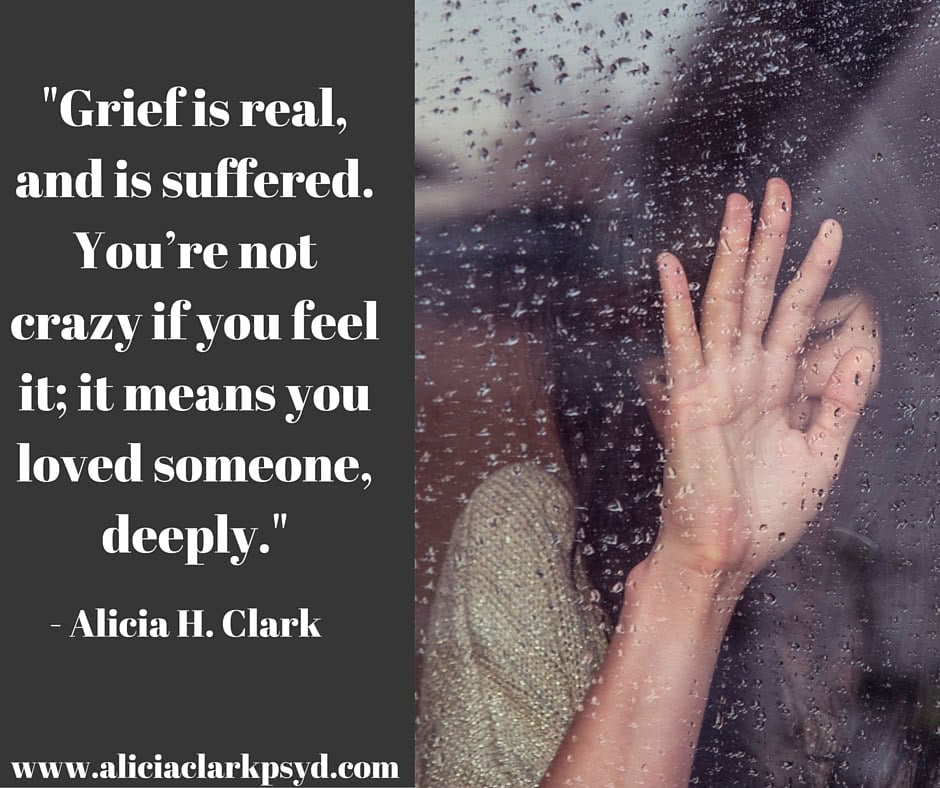
You’re not crazy if you feel it; grief is real, and grief is suffered.
It means you loved someone, deeply. The experience of losing someone you love can make you wonder if you’ll ever be ok, especially facing life now that everything is different. More than just being sad, grief can have many different faces, affects each of us differently, and is a process to be experienced.
Understanding and recognizing some of the surprising aspects of normal grief can help you understand what you’re experiencing so you can take at least one thing off your overflowing plate: you don’t need to worry about going crazy.
Here are 6 Ways Grief Affects Your Life That Are Normal, Natural & Often Unpreventable
#1 Grief and Your Emotions
Deep sadness, and gut-wrenching pain, pave the road of missing a loved one you weren’t ready to let go. Of course, you want them back. You want things how they were, and don’t want to change – every time you think of the future without them, the tears keep coming.
Sometimes tears feel like they won’t stop, which can be unsettling, even scary. You might wonder if you will ever stop crying… will you ever be ok? You will, but it will take time and the pace of healing is different for each of us. In the meantime, know that shedding tears is one of the most efficient things you can do to facilitate healing.
#2 Feeling Like You Don’t Care
Grief can feel physically heavy, like you are walking through quicksand, literally, at times. You do your best to go through the motions everyday, but things take longer and everything feels harder. Your energy only goes so far, and it just doesn’t feel like you have enough. Worse, you might not care. Grieving is hard work, and it takes a toll on your energy, focus, and drive. The good news is that with time, you will regain your interests and energy as you adjust to your new reality.
#3 Grumpiness & Moodiness
Coping with loss can make even the most easy-going person short of patience. Life just isn’t right anymore, and wrestling with this new reality can leave you feeling irritable and distracted. This simmering frustration can loom in the background of everything you do, consuming more of your precious energy than you might imagine. This can leave you with less energy and patience than you need for others, and yourself.
Understanding the physical and emotional causes of your irritability can help you recognize what’s going on for you. As you work through loss, aim to mitigate irritability by prioritizing self-care.
#4 Grief Fog
Grief can make it hard to sustain attention and concentrate, leaving you as mentally exhausted as you are physically so. This might be one of the most distressing aspects of grief: feeling mentally depleted at a time when you need all of your resources to cope.
Not only do life’s responsibilities march on during grief, but death can usher in even more responsibilities for survivors. Laying a loved one – and their affairs – to rest requires focus, energy, attention to detail, and patience at a time when you simply aren’t at your best. Try not to worry if everything feels a bit harder than it should, or if you can’t accomplish the things you usually can.
Grief can make you wonder if you’ll ever be ok, but remember, you will be. You may not be at your best, but you’re not crazy; you’re experiencing grief. When mental fog strikes, look for places where you can reduce expectations of yourself, whether cutting corners, or putting off nonessential tasks.
#5 Grief is Shared
Losing a loved one is a family affair, and often occurs in the context of having to care for others while caring for yourself. Moreover, family discord can be fueled by a shared loss, as painful emotions and their typical coping mechanisms, run their course. Remembering you are not alone can help bolster compassion for your loved ones, and for yourself.
#6 Sleep Changes
Not only is grief emotionally draining, but it can be physically draining too. Sleep can be a victim of grief: it can become increasingly hard to go to and stay sleep, and for some, sleep doesn’t even feel restful. Dreams tend to amplify as you cope with this new reality, and loved ones are often the subject of these wishful dreams. This can make it harder to wake up and face anew the realities of loss. Try not to get spooked by your dreams – they are your mind’s way of processing loss and adjust to your new reality.
In 1969, Swiss psychiatrist Elisabeth Kubler-Ross developed what she called the five stages of grief that can occur along the path to healing from a loss. In addition to elucidating the various expressions of loss, her model highlights grief as a fluid process, rather than a static event, as well as one that is different for everyone.
Remembering grief is a unique experience for each of us can help you accept whatever path yours takes. The more gentle you are with yourself and the process, the smoother it will all go. Even though grief can make you wonder if you’ll ever be ok, it’s important to remember that you will.
Being gentle can also involve getting help if you are stuck. There are numerous counselors, support groups, and other community resources dedicated to grief help often accessed by a quick google search, or a call to a trusted friend in-the-know. Asking for help when you need it is sometimes one of the bravest things you can do to take care of yourself even if grief is making you wonder if you’ll ever be ok.
Grieving takes time, and goes smoothest when it has space, time, and most importantly, love. At its core, grief is about love. The love for the departed that lives on in your heart, and the love that person had for you that lives on in you. Showing love to yourself and others is one of the best ways to honor the love you shared, and facilitate the healing you need.
It will happen – give it love.
Grief FAQs
What does grief feel like?
The experience of grief is different for everyone, the severity of which tends to relate to the closeness you felt with your loved one when they were alive. Acute grief is a full-body sad-to-your-bones experience of ongoing sadness, tearfulness, despair that can feel physically painful, disorientation, irritability, fatigue, and mental fogginess. You can experience some or all of these symptoms, and they can be nonstop or come in waves. There is no one right or wrong way to grieve. So long as you are facing your loss and aware of your feelings, you are grieving.
Does grief cause brain fog?
The world seems to stop when a loved one passes away, and grief becomes a round-the-clock mental priority. Nothing feels more important to you than grieving and nothing really is. Grief takes over your life in order to help you cope, and survive. And this process is exhausting.
In addition to its emotional and physical toll, grief can also exhaust your mind, leaving you feeling foggy and unlike yourself. This mental exhaustion, sometimes referred to as brain fog, can make it hard to focus, think clearly, and remember things. At a time when you need every resource you have, brain fog can be scary and frustrating.
The important thing to remember is that your brain will heal, and your cognitive exhaustion will abate. This is not your new normal, and you will feel like yourself again. In the meantime, know your brain is working hard to help you process this loss and needs rest and care to do its job. Aim to be patient with yourself and put off any tasks you can until you feel more like yourself.
Why does grief come in waves?
Thoughts of your loved one tend to take over in the wake of a loss, with memories and sadness surfacing often. Anything can remind you of your loved one, triggering a wave of grief as your emotions come flooding back and overtake you. One minute you’re living your new reality, the next, you’re whisked back into the past and grieving your loss like it just happened. Whether it’s a memory of your loved one, or a remembering of your grief itself, when you get triggered to remember, your feelings will always follow. And this is how grief can seem like it comes in waves, unpredictability flashing up as memories are triggered and overcoming you with emotion, then calming down and passing.
These waves of grief are thought to represent the emotional experience of reconciling two very different realities: the life you have known and lived before the loss, and your life afterwards, without your loved one. Feelings about this grueling transition tend to be most intense and frequent at the beginning of bereavement, and slowly diminish in both intensity and frequency with time and acceptance.
Can grief cause anxiety?
With few experiences threatening our internal sense of stability and safety more than grief, anxiety and grief go hand in hand. To grieve is to feel uncertainty and fear. There is simply no way to process life getting turned upside down without feeling disoriented, and spooked. Moreover, you may feel understandably afraid of what life will be like now, and if you can cope. The uncertainties of life after a loss are real, and it can take time to regain the sense of control you need to cope. Instead of getting spooked by your grief anxiety, try instead to be patient with yourself. Simply remembering anxiety is a normal part of grieving can help you manage and work through it.
For many, anxiety can be a challenging component of grief, and complicate the healing journey, especially when your anxiety keeps you feeling trapped in negative feedback loops.
When it comes to managing catastrophic thinking my online interactive course Breaking Free From Obsessions Solution can help. Designed to help you take control of never-ending worries and the feedback loops that support them, this course can help you take control so you can find the peace of mind and confidence you crave, starting right now. Click here to claim your spot.
Updated January 18, 2024